
The Playbook · Chapter 05 · UK Black History Month
Black history.
Big stories.
Learn through play.
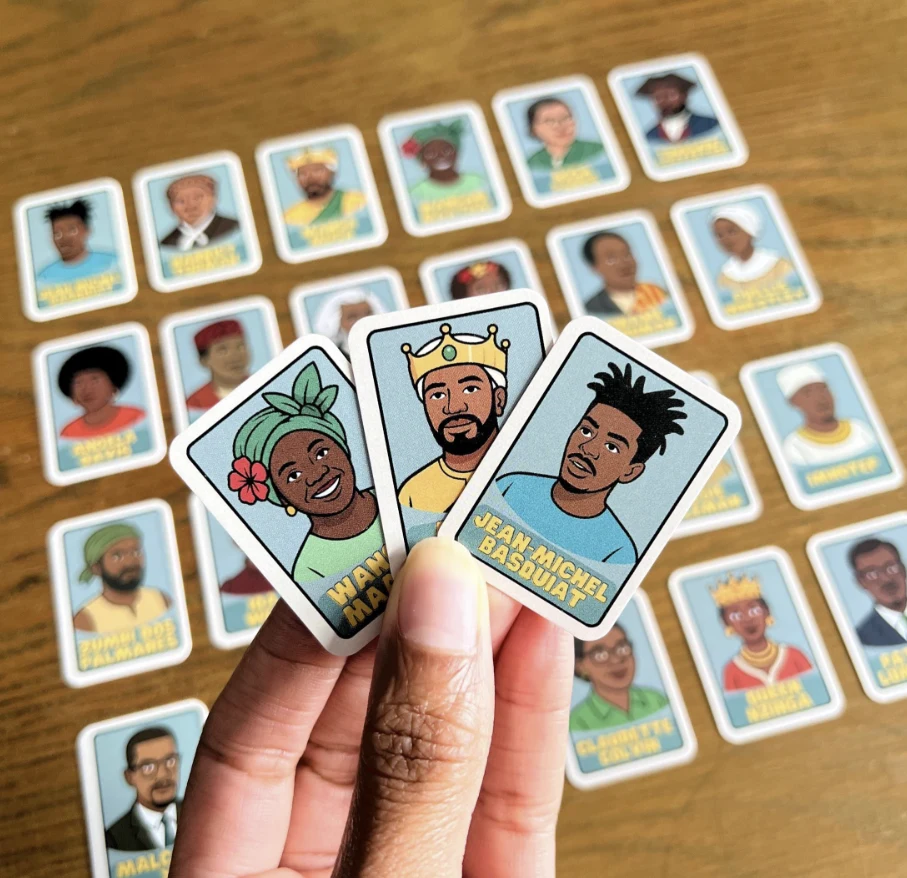
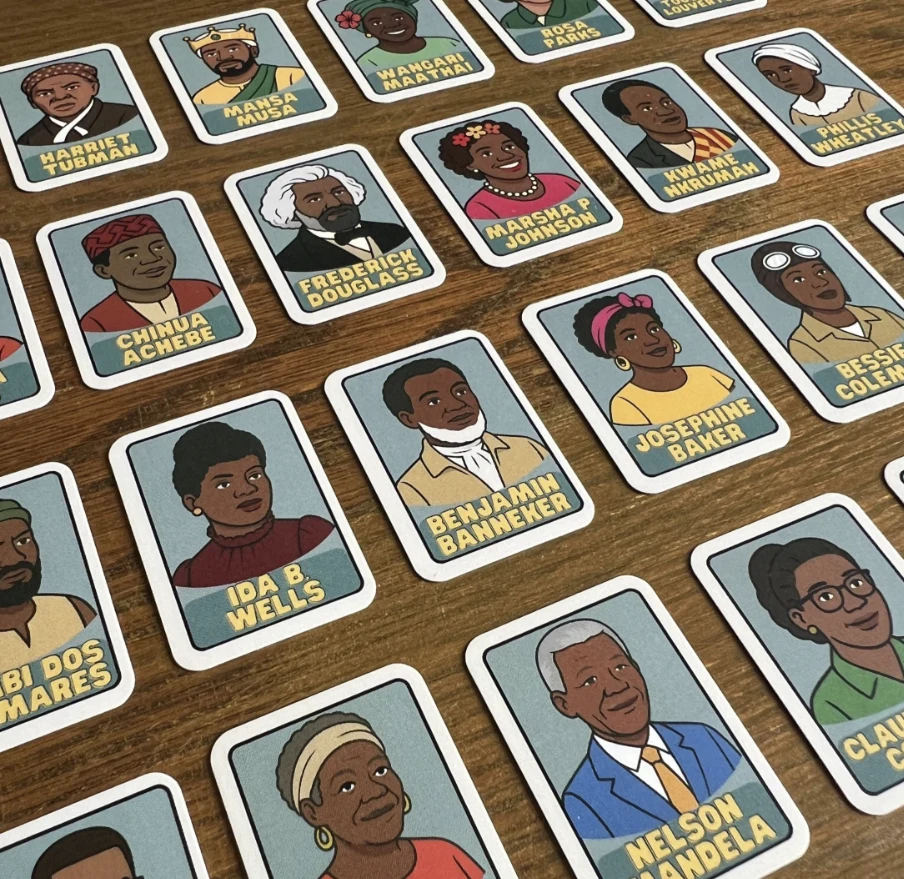
Twenty four impressive faces with stories from across the world and across history. Explore our printable Black History Guess Who game and learning activities, perfect for adults and young people
For KS2 & KS3 · Teachers & families · Updated 16 October 2026 · By Childish Canveeno
Why make space for Black history?
Black history helps us build a fuller picture of the world: who created, who organised, whose ideas travelled, and whose contributions deserve more attention.
It includes resistance to racism and injustice, alongside creativity, scholarship, community, leadership and everyday life. Learning about it can invite young people to question whose stories they already know, whose voices they have not yet heard, and where they might look next.
In the UK, Black History Month takes place in October. It is a useful invitation to begin or deepen that learning, with room to keep going throughout the year. Read more
At Childish Canveeno, we love a game that gives people something to talk about. The guessing is the starting point; the conversations are where you can take it further.
A global set for Black History Month in the UK
This edition brings together figures from across Africa, the Americas and the Caribbean. It is a global Black history selection, rather than a dedicated Black British set.
For a UK classroom or family, that opens up two useful paths: discover the people in the game, then explore how their stories connect with Britain and with Black British history closer to home.
Some connections are direct. Others are a starting point for comparing different places and experiences. Keep those distinctions clear: a connection with Britain does not make someone British.
Four people to meet beyond the portrait
Tap a face card to spin it around and discover the facts. Tap again to meet the face behind the story.
Frederick Douglass. Century: 19th Century. Location: United States. Bio: An American abolitionist, writer and speaker who escaped enslavement and campaigned for equal rights. His speeches and autobiographies challenged slavery; he also campaigned in Britain and Ireland.
Frederick Douglass: using words to challenge slavery
Frederick Douglass escaped enslavement and became an influential American abolitionist, writer and speaker. His campaigning also brought him to England, Scotland and Ireland in 1845–1847. His story offers a direct route from the game into conversations about campaigning across borders. Click to learn more
Phillis Wheatley. Century: 18th Century. Location: United States. Bio: The first African-American woman to publish a book of poetry, challenging notions of race and intellect.
Phillis Wheatley: a literary connection with London
Phillis Wheatley's poetry collection, Poems on Various Subjects, Religious and Moral, was published in London in 1773. She travelled to London in connection with its publication. Her story invites questions about who gets to publish, whose writing reaches readers, and how books travel between countries. Click to learn more
Wangari Maathai. Century: 20th–21st Century. Location: Kenya. Bio: Environmentalist and the first African woman to win the Nobel Peace Prize for her Green Belt Movement.
Wangari Maathai: caring for people and the environment
Kenyan environmentalist Wangari Maathai developed the Green Belt Movement, connecting tree planting with women's lives, environmental conservation and community action. She received the Nobel Peace Prize in 2004. Her story can connect a history conversation with geography, science and the green spaces around us. Click to learn more
Claudette Colvin. Century: 20th Century. Location: United States. Bio: At age 15, she refused to give up her bus seat to a white woman—months before Rosa Parks.
Claudette Colvin: young people belong in history too
In March 1955, teenager Claudette Colvin challenged bus segregation in Montgomery, Alabama, months before Rosa Parks's arrest later that year. Studying both women is a chance to explore a wider movement, rather than treating change as the work of one person alone. Click to learn more
A Black History Month activity: play, discover, research
You do not need to turn family game night into a formal lesson. Try this sequence at home, or adapt it for a classroom session.
- Meet the people. Read a small selection of information cards together. Check unfamiliar names and words before starting.
- Play a round. Begin with the familiar guessing format. Keep the information cards available so nobody needs to arrive with all the answers.
- Try a knowledge round. Use questions grounded in the cards: “Was this person a writer?”, “Did they work in the twentieth century?” or “Is Kenya connected with their story?” Agree how to handle people whose lives span several places or periods.
- Choose one discovery. Each player picks someone they want to learn more about. Find a reliable museum, archive, library or other suitable source together.
- Share one fact and one question. What did you discover? What would you still like to know?
Keep the emphasis on people's lives and contributions. Avoid guessing someone's nationality, beliefs or achievements from their appearance. The biographies are conversation starters, not complete accounts of a life.
Make it work for you
Choose your setting and open a box for a few ideas to get started.
Key Stage 2
Start with four to six people, read aloud where helpful, and use a map or simple timeline. Invite children to explain one contribution in their own words. Partners can work together on questions and reading.
Key Stage 3
Compare two sources about the same person, explore the context behind an achievement, or investigate how a short biography selects what to include. Ask what a card leaves out, and how you would verify it.
For Families
Let curiosity lead. One round and one new story is a useful starting point. Return to a different person another evening, or look for a related book at the library.
A helping hand for the bigger questions
Starting thoughtful conversations
For guidance on talking about racism, identity and fairness in ways that suit the children you are supporting, these resources offer practical starting points:
- UNICEF: talking to your children about racism — suggestions grouped for under-fives, ages 6–11 and ages 12+, with ideas for listening and answering questions.
- YoungMinds: a guide for parents and carers — practical advice on conversations about racism and supporting a young person’s feelings and experiences.
- BBC Teach: The Colour of My Skin teaching guidance (PDF) — preparation and discussion guidance for teachers working with secondary pupils.
Bring the learning closer to home
Pair the global set with a separate Black British research activity. For example, explore Mary Seacole, the Jamaican-born nurse and businesswoman who cared for soldiers during the Crimean War and later lived in London. English Heritage's account provides a starting point. She is not included in this edition. English Heritage
Then investigate a person, organisation, exhibition or place connected with Black history in your own area. Your local museum, archive or library may help you find a story beyond the familiar names.
Try this prompt: “If we made a local history card, who would we research, and what evidence would we use?”
Print, prepare and play
The digital edition includes 24 character portraits, printable biography cards and optional card backs. You print and assemble the pieces yourself; a physical game board is not included in the digital download.
Choose the face-card size that fits your board:
- 3 cm × 3.5 cm
- 1.125″ × 1.75″
Measure your board's inserts before choosing a size, and test one page at actual size before printing the full set. Board versions vary.
Use 200–300 gsm card for the face inserts if your printer supports it. Regular card or paper works for the biography cards. Scissors or a paper trimmer will help with cutting; optional backs can be used for double-sided printing. Check your printer's alignment with a test sheet first.
Prefer a printed pack? Email childishcanveeno@gmail.com to ask about availability and a delivery quote.
Make room for the next question
Choose a face. Discover a contribution. Find the story beyond the card.
Use Black History Month as an invitation to explore together, then keep those books, questions and conversations in reach when October ends.